Monday, November 23, 2020

Informational Nonfiction

 If Sharks Disappeared by Lily Williams
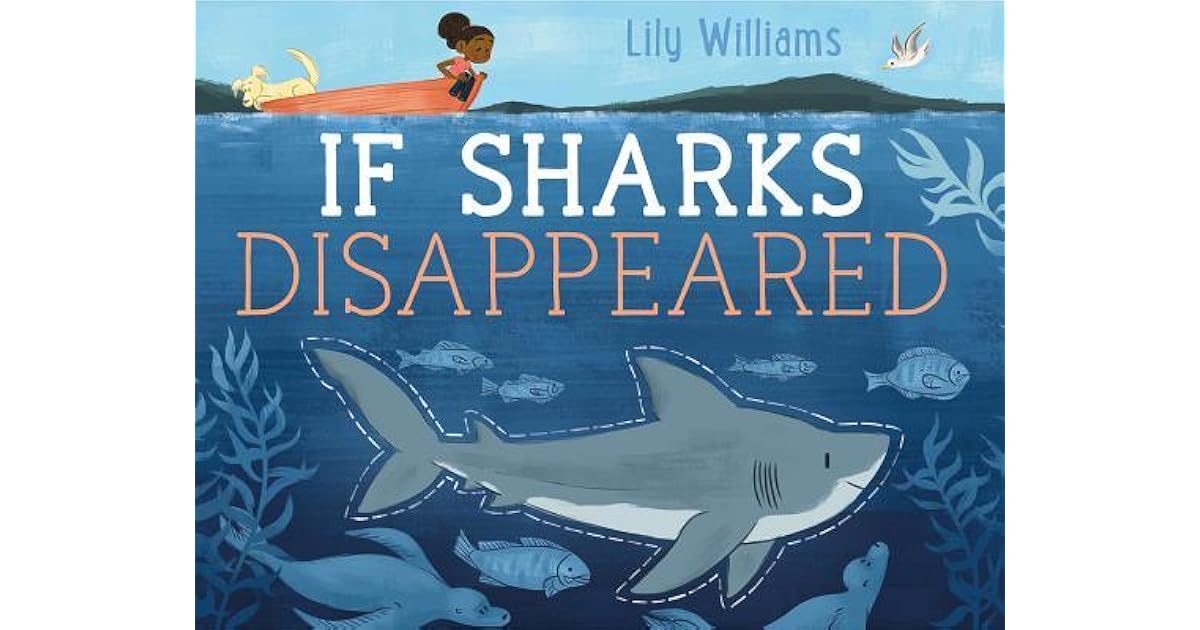
If Sharks Disappeared by Lily Williams

Summary:

This book talks about the ocean and how certain species help to maintain balance within the environment. It has illustrations to show the good that sharks do, and the bad things that could happen to the environment is sharks were to be extinct. The book tells how the sharks not only keep the ocean in balance, but also land.


Evaluation:

This is an informational nonfiction book as it gives factional information on the topic, how sharks help to maintain balance within the environment, and what could happen if they were to become extinct.  The setting of this book is mostly in the ocean, but also some on land, as it describes the effects on land as well.

The illustrations in this book are outline style, giving it a cartoon feel. The elements used include line and color to help attract the readers attention to the visuals that help to reiterate the topic of the book.


Activities:

Before reading the book, you could ask the children what they know about sharks and what they think might happen if sharks disappear. Then compare and contrast after reading the story.

You could also have the children draw a picture of the ocean and/ or write their own short story of what they think might happen is a different animal became extinct.


Personal Thoughts:

I thought this was a great book for children. It can give children a different perspective on sharks, rather than just thinking that they are these big, scary, mean creatures who do nothing for the environment.


What are you thoughts on giving children a different outlook on sharks? Obviously we don't want them to go hunting sharks down, but I think it can give teach them to look at many things in a new light, help them to see the good in things that don't always seem good. 


Biography

Elvis is King by Jonah Winter 

 Elvis Is King! - Jonah Winter - by Lauren Ward - issuu

 Summary:

This is a biography about Elvis Presley, but told as a story, rather than a factual line-up. It starts when he born, through his middle school years, when he and his family are financially unstable. It talks about when he came into stardom and his relationships. The story ends with a note from the author that goes through more detailed facts of his life.


Evaluation:

The setting and plot of this story is the home, school, job of Elvis Presley when he was a child. The story takes place in Mississippi, Memphis and is told in chronological order. It is told as a story which is more likely to keep the attention of children.

The illustrations are really neat. They use outline style, but the characters almost appear to be made out of clay. They also use texture and bright colors to depict the emotions of the settings in the illustrations.


Activities:

One fun activity would be to have the children write a story based on their lives and have them includes facts about themselves and events/ memories they have.

Another fun activity would be to have them write a song/ poem and then share it with the class. This could be a group activity and the kids could work together in groups on this.


Personal Thoughts:

 As a child, I LOVED Elivs Presley so I especially enjoyed this book, this is something I would have loved to read as a child, because it was full as facts about him and his life, but they were told within a story rather than on a factual time line, which made is even more intriguing. 

What are your thoughts on biographies such as this one? Ones that include the facts but are told as a story rather then a time line? Do think they can cause confusion between fiction and nonfiction for children?


Thursday, November 19, 2020

Historical Fiction

 Sweet Clara and the Freedom Quilt by: Deborah Hopkinson


Summary:

This book is about a young girl who was raised into slavery, away from her mother. She is a field hand, and her "aunt" teaches her how to sew so she can get out of the field and become a seamstress. Over the years she works on sewing a quilt. The quilt symbolizes freedom, and helps others to gain the courage to free themselves from slavery.

Evaluation:

This is historical fiction as it a fictional story based on true events that have actually happened in the past, it refers to the underground railroad. The characters behave as they would have in that setting versus how people would act in in the present, with actions that were common for that time period, for this book it was working in the field and being a seamstess.

The illustrations in the book use representational art to depict the characters in a realistic manner. The illustrations utilize the elements of color and texture to bring the culture of the story to life.


Activities:

Children could get different fabrics or old clothes from around their house and use the fabric to make a tie quilt with the help of their teachers, and tell the class about what the different fabrics and the quilt mean to them.

Older children could compare this story to a nonfictional story about the underground railroad and compare and contrast the two.


Personal Thoughts:

I enjoyed this story. I feel like it helps to give some insight into some of the struggles that other cultures faced in the past. It lets children see a little bit of the past, and can help them to open their minds to learning more history.  

Are children ever too young to learn about bad/ sad events that have happened in the past; slavery, war, etc.. ? 

What are your thoughts on using historical fiction as a gateway to introducing children to these types of events?

Personally, I think is good for children to learn about these things at a fairly young age, and I think using historical fiction is a good way to introduce it. These stories can give a softer version of the harsh realities that people in these times suffered. Giving children the knowledge of the past, without the gory details.


Reference:

Hopkinson, D. (2003). Sweet Clara and the freedom quilt. New York, NY: Knopf.

Realistic Contemporary Fiction

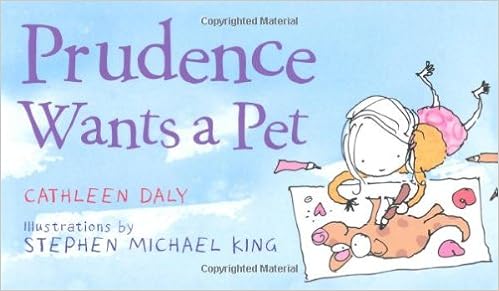
 Prudence Wants A Pet  by: Cathleen Daly

Prudence Wants a Pet: Daly, Cathleen, King, Stephen Michael: 9781596434684:  Amazon.com: Books

Summary:

There's a little girl named Prudence who wants a pet, but her parents won't let her have one. Prudence starts using other things as her pets, twigs, her brother, a tire, etc. Each "pet" she gets, she either loses, does not properly care for, or she finds it a new home. Eventually her parents surprise her on her Birthday with a special gift... a cat, and she takes great care of him.

Evaluation:

This is a realistic contemporary fiction story, as it depicts a child in a situation that many children are able to relate to. More specifically, it's an "animal story"as it's about a little girl who wants a pet. Many children want a pet at some point but are not always allowed to have one. The setting is in a real setting; school, home, the park, etc. 

The illustrations are outline style. They use a mixture of color and line art throughout the story. The illustrations lack a back ground and focus on the main character and her pets.

Activities:

A fun activity for young children would be to have them find an item at home and treat it as if it were their own pet. They could give it a name, walk it, feed and water it, etc.. This will help them to use their imagination and create a story of their own. 

Older children could write or tell their own short story about either a real pet or make believe pet of their own.

Have you ever had an imaginary pet? If so, how far did your imagination go with the scenario?


Personal Thoughts:

I thought this was a cute book. I'm sure many children can relate to this situation, I know when I was a child I wanted a dog so bad and my parents kept saying no, but eventually got me one for Christmas. After I got the dog, I realized why they were so reluctant. Pets can be a lot of work. 


Reference:

Stanley, G., & Henderson, M. (2005). Crazy Horse Young War Chief. New York, NY: Aladdin Paperbacje.

Monday, November 9, 2020

Multicultural Folklore

La Princesa and the Pea   By: Susan Middleton Elya

La Princesa and the Pea: Elya, Susan Middleton, Martinez-Neal, Juana:  9780399251566: Amazon.com: Books

Summary:

This is a version of "The Princess and the Pea" that includes a Hispanic twist. It is about a Prince who meets a girl that he wants to marry, but his mother is very particular. The mother puts the girl through a test to see if she is a real princess, by putting a pea under her bed to see if she can feel it. The girl passes the test, with the help of the Prince and they get married.


Evaluation:

Based on what I've read in the text, this story is a "noodlehead folktale." This book is cute and has funny parts to it to really keep the children engaged.

As many of the other stories I've read, the illustrator uses outline style to give it a "cartoon" vibe.  They also include elements of design and textiles native to peru, which gives the illustrations so much character.


Activity:

It would be fun to have the kids create their own drawings/ art work using textiles similar to those illustrated throughout the book. The design elements throughout the book are so pretty and it would be a great are project. 


Personal Thoughts:

 I really enjoyed the retelling of this story. I enjoyed this story when I was a child and it's nice to see that authors are re- telling these stories with a new spin on them. I also love that this story includes some Spanish! This great for multicultural class rooms and also for just having children hear a different language.

Can you recommend any books that put a multi cultural spin on classic tales that you enjoyed as a child?

What do you think the benefits are of reading a story to children that includes more than one language throughout the story?


Folklore


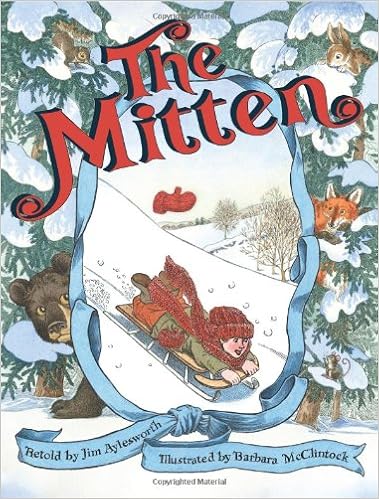
 The Mitten    By: Jim Aylesworth


Summary:

This story is about a little boy who lost his mitten outside when he was playing in the snow, but he did not realize it until he got back home and decided to wait until the next day to find it. Overnight, a squirrel found the mitten and went inside to get warm. Shortly after came a rabbit who asked to join the squirrel inside the mitten. Initially the squirrel said no and then decided to let the rabbit come in too. Then one at a time came a fox, a bear, and a mouse... all snuggled up inside of the mitten. They all went to take a deep breath and the mitten bursts, leaving them all to find shelter somewhere else. The next day the boy when to find his mitten, and found the yarn all over the ground so hid grandmother knitted him a new one.


Evaluation:

This is a folktale that includes animals that talk to each other, but to humans. This story includes rhyme in some areas, but not throughout the entire book, I think this helps children to see a cycle throughout the story.

The illustrations are simple. The illustrator used outline style and included elements of color and texture. The illustrations focus on the characters of the book more than the back ground scenery.

Activity:

Children could take a glove, mitten, or even a sock of their own and see how many toy animals they could fit inside it. Obviously it would not burst as the mitten did in the story, but this would be a fun activity for young children and could also help them with their math skills by counting how many toy animals they were able to fit. 

Another activity would be to take a big blanket and see how many children could fit under it, this would be a way to get children more interactive with each other. 

Personal thoughts:

I enjoy this story, I chose it because I used to read to the children at the childcare center I worked at. In comparison to some of the other books I've read recently, I would say the illustrations in this one were not my favorite. The illustrations are a little bland as most of them only focus on the main characters of the book and do not include back ground scenery, which I think is very helpful in stimulating the imagination.  

Have you every read this book? If so, what are your thoughts on the illustrations?

What do you think the moral of this story is?


Tuesday, November 3, 2020

Science Fiction


 Toys in Space by Mini Grey


Summary:

This book is about children's toys that are left outside at night. Once the sun goes down and it gets dark, some of the toys become afraid, so one of the other toys tells a story to them. The story is about the toys going to space and finding a bunch of other lost toys and returning them to their homes. When the story is over, the sun has risen and the toys are happy and safe.


Evaluation by genre and illustrations:

This is a science fiction book that includes magic and magic realism. Science fiction comes into play as it includes outer space and the idea of aliens. It also includes magic and magic realism, as the toys are able to travel to outer space and complete a quest of returning other lost toys to home.

The illustrations use the outline style to help tell the story and includes the elements of color and shape to keep the readers attention.


Activity:

A fun activity for children would to have them think about the things they think they might find in outer space, and what they would do with those things if they found them.


Thoughts:

I thought this was a cute book, probably not my favorite. I was not too crazy about the story line, I think the author could have made it a little more exciting for the readers. I did, however, enjoy the illustrations that went along with story, which was why I originally chose this book from the library. 

What do you think about reading a story to children that includes aliens?

Do you think this could be a scary thought for them or would it help to peak their imagination?


Reference:

Grey, M. (2013). Toys in space. London: Random House Children's Books, London.


Chilren's Fantasy Book

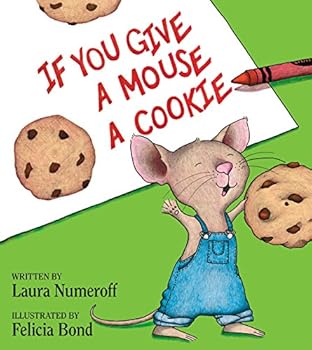
 If You Give A Mouse A Cookie by Laura Joffe Numeroff

 Hardcover If You Give a Mouse a Cookie Book

Summary:

In this book, a little boy gives a mouse a cookie, and this strikes up a series of activities that the mouse wanted to do. Each activity provokes the mouse's thought of the next activity/ thing he wants to do.. he was given a cookie, which made him want a glass a milk,  then a straw,  then a napkin, etc. At the end of the book, the mouse wanted another cookie.


Evaluate by genre and illustrations:

The genre of this book is fantasy, specifically "animal fantasy and miniature worlds." This type of fantasy is when an animal is portrayed as having the same kinds of thoughts and actions as a human would. 

The illustrations were done using outline style, which can help the reader to understand the story even without reading the words. They also include the elements of line and color to attract the readers attention.


Activity:

A good activity for a child would be for them to think of an animal, whether it be their own pet, an animal from the wild, or even an imaginary creature, and tell their own story of what would happen if they gave that animal/ creature something they like. I think it would be fun to hear about what series of events may ensure afterwards, and it would get their imaginations flowing.


Personal Thoughts:

I enjoy this book, I used to read it to the preschool children at the child care center I worked at all the time and the children really enjoyed it as well. In comparison to more recently published books, the illustrations seem a little dated, but overall I think it is a really cute and fun book for children.

This author has some similar books, including If You Give A Mousse A Muffin and If You Give A Pig A Pancake.. Have you read any of these books?

If so, what are some thing you like or dislike about her books?


Reference:

Numeroff, L. J. (1985). If you give a mouse a cookie. New York, NY: Harper.

Multicultural

 Same, Same But Different by: Jenny Sue Kostecki- Shaw Summary: This book is about a boy who draws a picture of his world and his teacher s...